IVR in 2026: Is Legacy Phone Self-Service Still Fit for Purpose?
March 10, 2026
Time:
8
mins


Interactive Voice Response (IVR) technology has been around for decades. For many businesses, it remains the default front door to customer support.
IVR earned its place by helping contact centres manage high call volumes and route callers. But service standards and consumer behaviour have evolved massively since its creation.
Today's customers expect fast, low-effort support that gets them to a resolution quickly and efficiently. Not long menus, dead ends, or repeating themselves when they reach an agent.
At the same time, IVR often falls short for businesses as well as callers. It can increase cost-to-serve, drive customers away, and undermine the efficiency and service outcomes that contact centres are measured against.
Taken together, these issues raise some questions: Is IVR still fit for purpose in 2026 and beyond?
Can it support contact centre performance and meet evolving customer needs?
Is it the best operating model for voice customer service?
This article, along with our latest report, explores and answers these questions. We'll cover:
Legacy IVR still plays a role in voice support, but growing evidence shows that menu-driven phone journeys often increase effort, abandonment, and cost-to-serve.
This article explores why legacy voice self-service is under pressure in 2026, and how organisations can modernise towards conversational, resolution-first voice support in a phased way with minimum disruption.

IVR is an automated phone system that routes callers using recorded prompts, menu options, and keypad or voice inputs.
These systems were designed to support contact centres in two practical ways: transferring customers to the right team and reducing pressure on agents by handling basic, repetitive interactions.
When customer needs were simpler and expectations were lower, menu-based “press 1 for...” journeys were an acceptable trade-off. Businesses gained operational control over call flow, and callers tolerated structured options as a step on the way to a human agent.
This context also explains why IVR is still so common today.
In many organisations, it’s deeply embedded in existing telephony infrastructure, making change feel risky or disruptive. It's also a familiar, predictable technology that's fairly low-cost to maintain.
The issue, then, isn’t that IVR “does nothing”. The challenge is that it was built around inputs and routing, not intent and resolution.
Customers don’t call because they want to navigate a menu. They call with real questions and problems to solve. And the more complex those queries become, the harder it is for rigid IVR options to keep up.

The biggest challenge for IVR in 2026 is that the classic model still relies on outdated technology.
Rigid, decision-tree menus are easy to deploy, but friction arises when caller requests don’t fit neatly into them. This is increasingly common as customer needs become more varied and multi-part.
At the same time, service expectations have risen significantly. Customers don’t want to navigate long menus or wait in queues; they want to explain their issue quickly and reach an outcome fast, with minimal effort.
That means speed, clarity, continuity, and efficiency matter far more than simply reaching the right queue. This is where traditional IVR often struggles, as it was designed to facilitate routing and deflection, not resolution.
In practice, customers often call with multiple queries or a complex issue to explain. For example, a delivery issue plus a returns query, or a nuanced technical problem.
When predefined menu options don't map cleanly to these real-world situations, people guess, backtrack, or end up in the wrong place.
As organisations try to stretch IVR to cover more and more scenarios, menus tend to grow. That creates a familiar pattern: longer lists of options, more time spent listening, more repetition, and more dead ends.
This also puts pressure on agents, as more calls and frustrated customers end up being pushed into live queues (and sometimes not even the right queue).
And because IVR is often treated as a “set and forget” system, those rough edges can persist for years without the same level of monitoring and optimisation applied to digital channels like live chat.
The impact of this on customer sentiment and behaviour is evident in research on IVR. For example, one study found that 61% of customers consider IVR a poor experience, and more than half have completely abandoned a business as a result of IVR.
Ultimately, the friction IVR causes doesn’t just frustrate callers. It also leads to repeat contacts, increased escalations, lost business, and avoidable costs for contact centres.
We’ll dive into the true impact of this in the next section.

It’s easy to talk about IVR as just an annoying experience. But the real impact of friction and inefficiency in IVR journeys goes far beyond customer frustration.
First, it can increase cost-to-serve. When callers choose the wrong option, reach a dead end, or abandon the call, the issue rarely disappears.
People call back, driving repeat contacts and pushing more demand into the most expensive part of the service model.
In theory, IVR should actually decrease phone support costs by routing calls correctly and resolving routine queries before they reach an agent. In practice, it often struggles to do this consistently.
The result is longer journeys and more effort for customers, plus a higher workload for agents and increased costs for contact centres.
Second, it can slow down resolution. Even when a customer reaches the right team, time is often lost to misrouting, unnecessary steps that could have been automated, and repeated information at handoff.
Third, it can damage customer loyalty, impacting retention and revenue. The phone channel is often used when something feels urgent, complex, or when digital self-service has already failed.
In those moments, a poor first interaction sets the tone. If the experience feels like a barrier, it undermines trust and increases the risk of drop-off or churn.
Overall, phone support is a high-effort channel for customers and a high-cost channel for organisations. When the front door to it adds friction rather than progress, the impact is felt across CX metrics, service performance, and revenue.

It’s clear that today's contact centres need more than the basic routing IVR provides, and their customers demand more too.
As a result, IVR is gradually being replaced or upgraded with conversational automation, powered by voice AI technology. These modern solutions are designed to overcome the pitfalls of IVR by delivering:
The goal is not simply to make voice interactions more conversational. It’s to eliminate bottlenecks in the journey and help customers reach a resolution faster, while keeping a clear path to human support for complex or sensitive cases.
For customers, the voice AI experience can significantly reduce effort and friction. It supports continuity across handovers and true self-service, as well as providing more natural, human-like interactions.
For contact centre teams, the impact on service performance and efficiency can be significant. Research highlights examples where AI has reduced call volume, lowered average handle time, and improved first-call resolution (download the IVR in 2026 report to see the data on this).
And, unlike legacy IVR systems, AI-powered voicebots can evolve and improve over time through performance monitoring, analytics, reporting, and ongoing refinement.

When teams talk about updating IVR or modernising voice self-service, the first concern is often disruption.
Leaders worry it will mean ripping out existing telephony, replacing agents, or attempting a high-risk transformation that touches every call flow at once.
In reality, most successful teams take a far more incremental approach. Modernising phone support is usually a staged, integrative process, not an overnight overhaul of everything behind it.
Many modern AI solutions for voice can be integrated into your existing telephony or CCaaS setup as an additional layer. That means you can improve the customer experience and call handling without ripping and replacing your entire tech stack.
In practice, this kind of rollout tends to follow a progression, moving from pre-deployment planning to better routing and call handling, then into resolution-first voice self-service and ongoing optimisation:
The important point is that modernisation doesn’t have to be all-or-nothing. With an integrated, phased rollout, teams can prove value in one area, learn what works, and expand over time without disrupting what already works today.

If IVR is still your operating model for voice and you're thinking of modernising phone support, the most useful starting point is:
“Where are we adding unnecessary effort today, and what outcomes do we actually need voice self-service to deliver?”
The questions below are a helpful way to assess your current state and prioritise what to fix first:
These questions create a clearer picture of what “good” looks like for your organisation, making it easier to prioritise improvements without a big-bang approach.
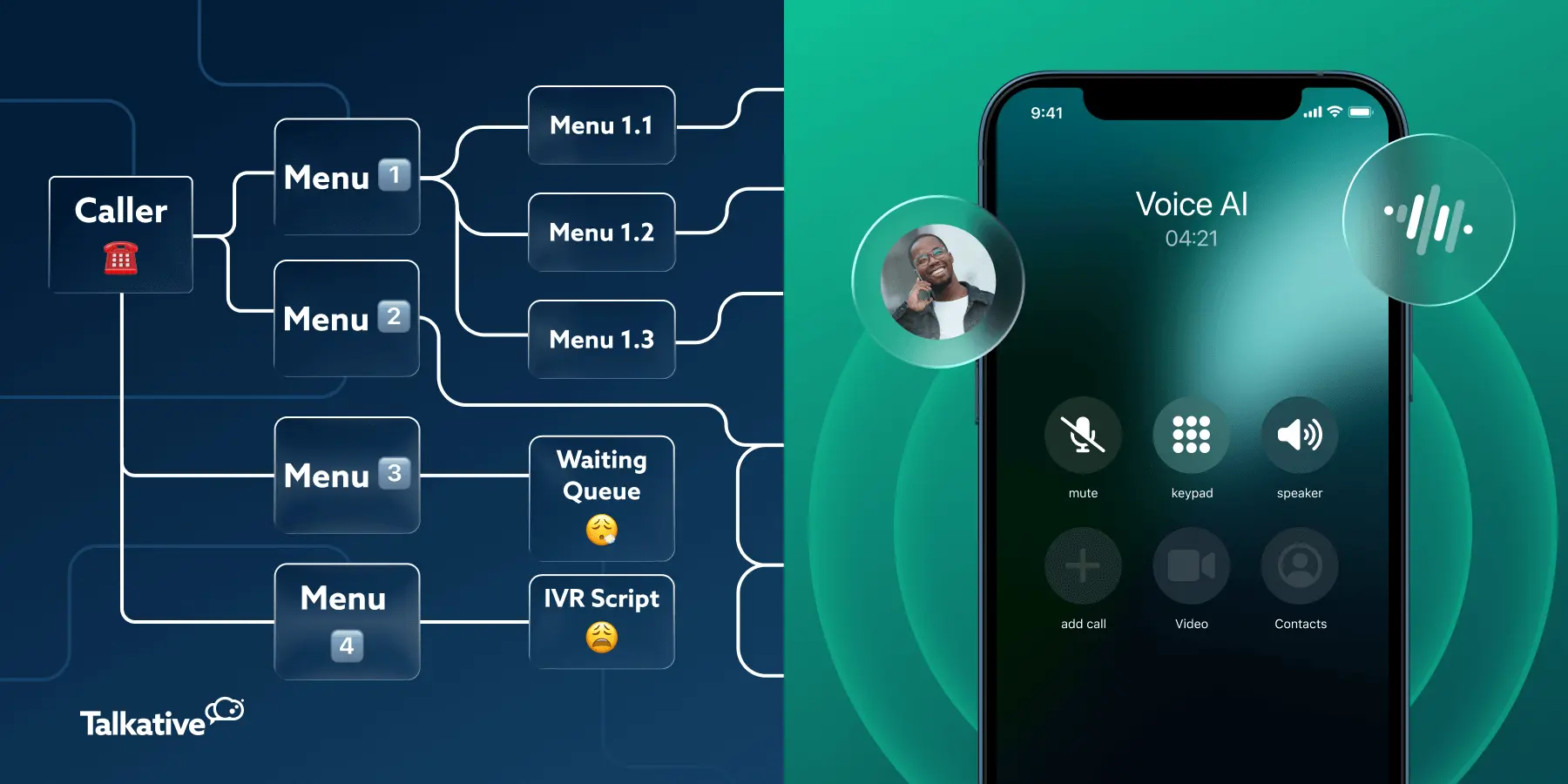
Legacy IVR was designed to deflect and route calls through fixed menus.
In 2026, customer expectations have shifted towards faster, lower-effort support that gets them to an outcome quickly.
The evidence is clear that menu-based journeys create friction, increase drop-off, and erode confidence in your business. All of which negatively impact customer retention, revenue, CX, and contact centre performance.
At the same time, modern AI-driven approaches are shifting the goal of voice self-service from deflection to resolution.
When done well, conversational voice self-service combines intelligent routing, warm transfers, knowledge-led answers, and task completion via integrations. It also supports a human-plus-AI model, where AI handles what can be automated reliably, and live agents focus on complex or high-value calls.
Our free IVR in 2026: The State of Legacy Voice Self-Service & What’s Changing report brings together independent research on IVR and voice AI, real-world benchmarks, and practical next steps for CX, customer service, and contact centre leaders.
It's designed to help you assess where IVR still adds value, where it’s starting to hold teams back, and how to modernise phone support in a staged, low-disruption way.
Download the free report here.
If you've got any questions about the report or would like to talk more about modernising IVR, please reach out to us anytime.
Get an evidence-based review of legacy voice self-service and what’s changing in phone support - with practical next steps for CX and contact centre leaders.


