Human-In-The-Loop AI Customer Service: How To Automate Without Losing Trust
July 2, 2026
Time:
8
mins


In 2026, many businesses and contact centres are using AI to answer questions, reduce queues, assist support teams, and give customers faster routes to resolution.
But although the potential benefits of AI in CX are huge, there will always be cases where the human touch remains essential
That’s where human-in-the-loop AI customer service comes in.
The goal with AI isn’t to remove live agents from the customer experience completely.
It’s to design a model where AI handles the right queries and tasks, agents stay involved where human judgement matters, and customers always have a clear route to resolution.
Done well, human-in-the-loop AI helps contact centres automate without losing trust or damaging CX.
In this article, we’ll cover:
Human-in-the-loop AI customer service helps contact centres automate customer support without removing the human touch from the moments that matter most.
AI can resolve many high-volume queries like order updates, bookings, product/service information, policy questions, and basic troubleshooting, while agents step in for complex, sensitive, emotional, or high-risk issues.
The key is to design automation carefully by:
Done well, this model improves efficiency while protecting trust, CX, and the human touch.

Human-in-the-loop AI customer service is a support model where AI handles high-volume queries and tasks, but agents remain involved when human judgment, empathy, or complex problem-solving is needed.
There are many common customer queries that AI can resolve autonomously from start to finish, for example:
But when a query becomes more complicated, sensitive, high-risk, or emotionally charged, AI should smoothly hand over to the right team or agent.
In these cases, AI may continue to help and assist the support agent behind the scenes by suggesting responses, retrieving relevant knowledge, or flagging sentiment changes during a live interaction.
The key is that AI and humans work together to deliver the best outcome for every customer.

AI can do a lot for customer service teams. It can:
For many contact centres, that’s exactly what’s needed.
But not every customer interaction should be fully automated.
Some queries involve nuance or complexity. Some involve personal circumstances. Some require empathy, discretion, negotiation, or policy interpretation. And some simply carry too much risk for AI to handle alone.
Additionally, 89% of consumers believe that companies should keep the option to speak to a human for those who need to. Taking that option away from them is may damage brand loyalty and retention.
This is why a human-in-the-loop model is crucial. Even as AI becomes increasingly capable, it’s not without limitations.
Human involvement helps improve service and solve AI limitations in five important ways.
First, it protects customer trust. Customers are more likely to accept AI when they know it won’t trap them in a loop or completely block them from human help.
Second, it improves escalation quality. When AI hands over at the right time, with context intact, agents can resolve issues faster, and customers don’t have to repeat themselves.
Third, it reduces operational risk. Sensitive topics, complaints, vulnerable customers, payments, cancellations, and compliance-related queries can be routed to agents when needed.
Fourth, it supports agents. AI can remove repetitive work while giving agents access to information, response suggestions, and guidance during complex conversations.
Finally, it keeps automation focused on resolution. The most important question with AI customer service isn’t whether AI avoided a handover. It’s whether the customer actually got the right outcome.
A strong human-in-the-loop model starts with a simple question: what role should AI play in each type of interaction?
Not every query needs the same level of human involvement. A password reset and a formal complaint should not be treated the same way.
Here’s a practical way to think about it:
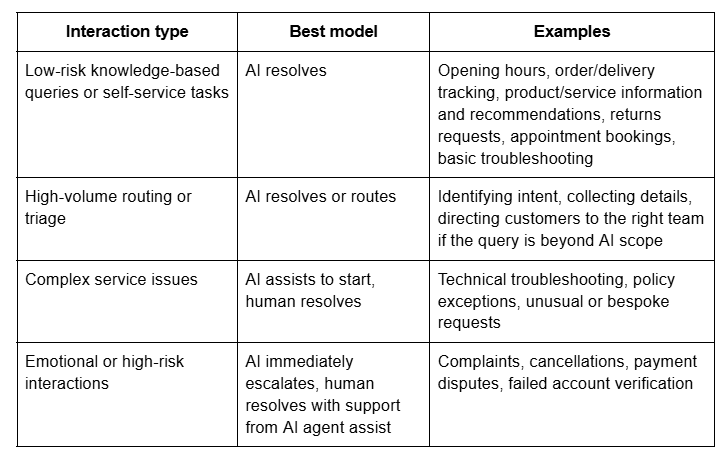
This is where many businesses go wrong in their AI customer service strategy. They treat automation as an all-or-nothing decision: either the AI handles customer conversations, or it does not.
The better approach is to carefully choose which tasks AI should handle, when agents should step in, what the handover process should look like, and how humans and AI should work together.
Ultimately, you need to decide where AI can create value safely, then build escalation paths around the moments where human judgement is still essential.

Human-in-the-loop AI works best when it’s built into your customer service operation from the start.
That means thinking about use cases, knowledge, prompts, escalation rules, handover quality, agent support, and reporting before you go live.
The strongest AI rollouts don’t try to automate everything at once.
They start with focused, high-value use cases where AI can deliver a clear customer and operational benefit.
That might include repetitive queries, order updates, appointment booking, basic troubleshooting, routing, or out-of-hours support.
The best candidates usually have four things in common:
Queries that are complex, emotionally sensitive, or dependent on human discretion should usually sit later in the roadmap.
This doesn’t mean AI has no role in those interactions. It may still help agents with summaries, suggested responses, or knowledge retrieval. But the final resolution should stay with a human.

AI customer service is only effective if it has reliable information to work from.
That means your AI should be grounded in approved company knowledge, such as support articles, policy documents, FAQs, product information, process guidance, and relevant customer data from connected systems.
Without that foundation, AI is more likely to produce vague, inconsistent, or inaccurate responses. In customer service, that can quickly create repeat contacts, complaints, and avoidable escalations.
A strong knowledge base helps keep AI responses accurate, consistent, and aligned with your real workflows.
It also gives teams a clearer way to improve AI performance over time, because gaps in responses can often be traced back to gaps in content.
The key is to treat knowledge management as an ongoing process, not a one-time setup task.
Policies change. Products change. Customer questions change. Your AI needs to change with them.

Human escalation should never depend on the customer fighting their way out of an automated journey.
Your AI must know when to hand over to live agents.
Common escalation triggers include:
These triggers are part of your wider AI guardrails. It’s important to remember that guardrails don’t just prevent hallucinations. They help keep AI useful, safe, and focused on resolution.
Escalation rules should be specific enough to protect customers, but not so restrictive that interactions get handed over unnecessarily.
This balance comes from testing, monitoring, and refining over time.
A poor handover can undo all the good work your AI has done.
If the customer has already explained their issue to AI, they should not have to start again once an agent steps in.
A strong human-in-the-loop model should pass useful context to the agent, including:
This is especially important in voice support. When a customer calls, explains an issue, and then gets transferred with no context, the experience feels broken.
In contrast, conversational Voice AI can capture details, route the caller, and support a smoother handover to the right team.
The result is better for everyone. Customers don’t have to repeat themselves, agents start with more context and have a better chance of resolving the issue quickly, the first time.

Human-in-the-loop AI isn’t only about deciding when customers should reach a person.
It’s also about giving your agents better support.
AI Copilot tools can help agents during live interactions by suggesting responses and next steps, surfacing relevant knowledge, summarising conversations, and flagging sentiment changes.
That matters because human agents often handle the most complex, emotional, or high-value interactions. If AI removes simpler queries from the queue, the remaining workload can become more demanding.
In that environment, agents benefit from extra support and assistance.
A well-designed AI Copilot can help agents respond faster, more confidently, and more consistently, while still leaving human judgement in control.
That’s the real opportunity: AI handles what it can, supports what it shouldn’t own, and helps agents perform better in the moments that matter most.

Human-in-the-loop AI should be measured by outcomes, not just automation volume.
If AI handles more conversations but repeat contacts rise, customers get frustrated, or agents receive poor handovers, the model isn’t working.
Useful metrics include:
You should also review transcripts and summaries regularly. Metrics can show where something is happening, but conversation data and reporting helps explain why.
For example, a rising escalation rate might mean the AI is being cautious in a useful way. Or it might mean your knowledge base is missing key information. Without review, it’s hard to know which is true.
That’s why human-in-the-loop AI needs ongoing optimisation.
The model should improve as your team learns what customers ask, where AI performs well, and where human involvement creates the most value.

The biggest mistake is treating human escalation as a failure.
It isn’t.
Escalation is only a failure when it happens too late, with too little context, or after the customer has already lost confidence. A timely handover can be the best possible outcome.
Another mistake is automating based on volume alone. High-volume queries are good candidates for AI, but only if they’re also clear, well-documented, and low-risk enough to automate safely.
It’s also risky to launch AI without enough knowledge governance. If your source content is outdated, inconsistent, or incomplete, your AI will reflect those weaknesses.
Finally, don’t leave agents out of the process. Agents know where customers get stuck, which queries cause frustration, and what information is needed for a good handover.
Your teams’ feedback is essential to building AI customer service that works in practice.

Human-in-the-loop AI is not a compromise between automation and human support.
It’s how contact centres make AI customer service trustworthy.
The goal isn’t to keep humans involved in, or removed from, every interaction. It’s to involve them at the right moments: when judgement, empathy, risk, or complexity demands it.
That’s how AI moves beyond basic deflection.
It resolves the queries it’s suited to, supports agents when conversations need a human touch, and gives leaders a safer way to scale customer service without damaging trust.
Talkative is built around that principle.
Our AI customer service platform helps contact centres deliver trusted AI and live support across voice, chat, messaging, and video, with knowledge grounding, prompt control, human escalation, and advanced analytics and reporting for continuous improvement.
If you’d like help designing a human-in-the-loop AI model for your contact centre, or you want to see what trusted AI customer service could look like in practice, Talkative can help.
Get in touch with our team today to explore how Talkative could support your customer service goals and help you automate more queries without losing the human touch.
Get an evidence-based review of legacy voice self-service and what’s changing in phone support - with practical next steps for CX and contact centre leaders.


