AI Resolution Rate: The Metric That Matters More Than Deflection
May 21, 2026
Time:
9
mins

AI customer service is moving fast.
Gartner predicts that by 2029, agentic AI will autonomously resolve 80% of customer service issues without human intervention, leading to 30% cost reduction.
That’s a big shift for contact centres, customer service teams, and CX leaders.
But there’s another side to the story.
Gartner also found that only 14% of customer service and support issues are fully resolved in self-service.
That gap matters. It shows that AI has huge potential for self-service, but only if it’s measured properly.
If contact centres focus only on how many conversations avoid a human agent, they risk rewarding the wrong behaviour.
A customer who gives up is not the same as a customer who gets their issue resolved.
That’s where AI resolution rate comes in.
AI resolution rate helps you understand whether your AI is genuinely helping customers reach the right outcome.
Not just whether it answered. Not just whether it avoided a handover. Not just whether the conversation stayed inside an automated flow.
The real question is: did the customer get what they needed?
In this article, we’ll cover:
AI resolution rate measures whether your AI is actually solving customer issues, not just avoiding handovers.

AI resolution rate is the percentage of customer interactions in which the customer’s issue is successfully resolved by AI.
The important part is how you define “resolved”.
In customer service, a resolved interaction should mean the customer reached a real outcome. That might mean:
That last point is important.
AI resolution rate should not be about forcing AI to handle everything. Some queries are too complex, sensitive, high-value, or emotionally charged for automation alone.
In those moments, a good AI Agent should know when to clarify, when to resolve, and when to hand over to a human.
That means contact centres may want to track two related metrics:
Separating the two gives you a more honest view of performance.
It shows where AI is resolving issues independently, and where it’s improving the wider service journey by capturing intent, gathering context, or routing the customer to the right person.

AI customer service metrics can get confusing because different vendors and contact centres use similar terms in different ways.
The most common metrics in this context are:
Containment and deflection can be useful to track if you’re looking at cost and queue reduction alone, but they don’t necessarily prove that a query was solved or that your AI is improving the customer experience.
That’s why the terminology needs care.
A conversation can be deflected without being resolved.
A customer can leave an AI chat without speaking to an agent because they got the answer they needed. But they can also leave because they couldn’t find the escalation option, got a generic answer, or simply gave up.
That’s why resolution rate is a stronger north-star metric for AI performance. It focuses on the customer outcome, not just the operational shortcut.

Deflection and containment rate still have a place. Contact centres need to understand how AI affects queue volumes, agent workload, cost to serve, and channel mix.
But when those metrics become the main measure of success, they can encourage low-value automation.
And low-value automation creates a dangerous illusion: the dashboard looks healthy, but customers are still working too hard to get help.
Imagine a customer asks about a delayed refund.
The AI provides a generic policy answer, but doesn’t check the customer’s order, confirm whether the refund has been processed, or explain what happens next.
The customer asks to speak to an agent, but the journey makes escalation difficult. Eventually, they abandon the interaction.
In this scenario, the query may have been successfully deflected, but nothing has been resolved.
Then, the customer may call later, send an email, complain on social media, or simply lose trust in the brand. The contact didn’t disappear. It was just moved somewhere else.
That’s the problem with treating avoided handovers as success.
A good AI Agent doesn’t block access to help.
It resolves what it can, clarifies when needed, and hands over with context when a human is the better route to resolution.

Containment rate is useful because it shows whether customers are staying inside an automated journey.
But containment alone doesn’t tell you enough.
A contained interaction could mean the AI answered accurately, completed the task, and saved the customer time.
It could also mean the customer got stuck in a loop, abandoned the chat, or returned later through another channel.
That’s why containment should be measured alongside resolution, repeat contact, customer satisfaction, and escalation quality.
The real question isn’t just whether the AI avoided a handover. It’s whether the customer got the right outcome without unnecessary effort.

Bad AI doesn’t really reduce demand. It redistributes it.
If customers don’t get a useful answer, they come back. They may switch from live chat to phone, from phone to email, or from self-service to a complaint.
That repeat demand creates hidden pressure across the contact centre.
AI resolution rate helps reveal whether automation is actually reducing effort, or simply pushing unresolved demand into another channel.

Resolution has long been a core contact centre metric because it connects efficiency with customer experience.
A high AI resolution rate is likely to correlate with positive CSAT scores and a better experience, because it means customers get their issues solved quickly and with minimal effort.
Ultimately, the best AI customer service doesn’t just reduce agent involvement. It reduces the work customers have to do to actually solve their problem.

AI ROI is much stronger when it’s based on outcomes, not just avoided contact.
If you report that AI deflected 70% of conversations, leadership may ask:
What happened to those customers afterwards? Did the contact centre actually reduce cost to serve, or did work move into another channel?
AI resolution rate gives contact centre leaders a more credible answer.
It connects AI performance to customer outcomes, operational efficiency, agent capacity, and repeat contact reduction.
That makes the business case easier to defend.
The basic formula for calculating AI resolution rate is:
AI resolution rate = AI-resolved interactions / total eligible AI interactions × 100
For example, if your AI Agent handles 1,000 eligible customer queries and 720 are successfully resolved, your AI resolution rate is 72%.
The key is defining what counts as “eligible” and what counts as “resolved”.
Eligible interactions should exclude noise, such as test conversations, spam, duplicates, greeting-only chats, abandoned sessions before intent is clear, and queries outside the AI’s approved scope.
A resolved interaction should mean the customer reached a real outcome.
Depending on the journey, that might be confirmed by customer feedback, task completion, no repeat contact within a set period, QA review, or a successful handover to an agent with the right context.
It’s also worth segmenting resolution rate by query type, channel, customer journey stage, and AI-only vs AI-assisted journeys.
A headline number is useful for reporting, but segmentation shows where AI is performing well and where knowledge, prompts, integrations, or escalation routes need improving.
This is where analytics becomes essential.
With analytics and reporting (more on this later), teams can go beyond the headline metric and understand why AI is performing the way it is - and how to improve it.

A strong AI resolution rate gives contact centre leaders confidence that AI is doing more than absorbing volume.
It suggests that:
That’s the difference between automation that looks good in a dashboard and AI customer service that works in real customer conversations.
AI should enhance the customer experience as well as increase efficiency and reduce volumes.
A good example of this is our customer, Healthspan, a leading UK health and wellness brand that achieved a 90% AI resolution rate for product queries and increased positive CSAT scores at the same time.
This shows how AI can successfully resolve a high volume of customer service queries without compromising customer satisfaction.
Results like these show why AI performance shouldn’t be framed as a trade-off between efficiency and customer experience.
Done well, AI helps customers get faster answers while giving agents more capacity for the interactions where they add the most value.

AI resolution rate is not a fixed metric.
It should improve over time as you learn from real interactions, refine your knowledge base, adjust prompts, strengthen integrations, and optimise escalation routes.
Below are the key ways to improve it.
The strongest AI rollouts don’t try to automate everything overnight.
They start with focused, repeatable queries where the customer need is clear and resolution can be measured.
Common examples include:
These use cases are common enough to create measurable impact, but structured enough for AI to handle reliably when it has the right information.
Starting here also helps teams build confidence.
You can measure performance, prove value, and expand once the AI is working well.

AI can only resolve queries accurately if it has access to the right information.
That includes policies, FAQs, support articles, product/service documentation, brand guidelines, and any other content the AI needs to answer customer questions correctly.
This repository of company knowledge is essential for resolution.
If customers keep asking “What’s your returns process?” and the AI can’t access the right policy information, the problem isn’t the AI’s ability or performance. It’s a knowledge gap.
The better your knowledge base, the more likely your AI is to consistently give accurate, useful, on-brand answers.

Successful resolution depends on behaviour as well as knowledge.
Your AI needs clear instructions on what it can answer, how it should respond, when it should ask clarifying questions, and when it should hand over to a human.
This is where AI prompts come in.
A well-written prompt defines your AI’s role, behaviour, tone, and rules, helping keep automated interactions accurate, consistent, and aligned with brand expectations.
This matters because unresolved AI interactions often come from poor conversation design, for example:
Good prompts help the AI behave more like a well-trained team member.
They keep the conversation focused on resolution, not just response generation.
.webp)
Sometimes customers don’t just need information. They need action.
They may want to:
If the AI can only answer questions, its resolution rate will be limited.
That’s why it’s important to connect AI to your other systems, third-party tools, and CRM, so that it can retrieve customer details and automate self-service tasks.
This integration is often the difference between answering and resolving.
A customer trying to book an appointment won’t get the outcome they need if the AI can only provide information.
They need the AI to understand what they’re trying to arrange, check the relevant availability, confirm the right details, and guide them through the process to achieve resolution.

Escalation is not the opposite of good AI. It’s part of trustworthy AI customer service.
Some interactions need empathy, assessment, compliance review, or human discretion.
In those situations, the right outcome is not to keep the customer trapped in automation. It’s to hand over smoothly to the right team.
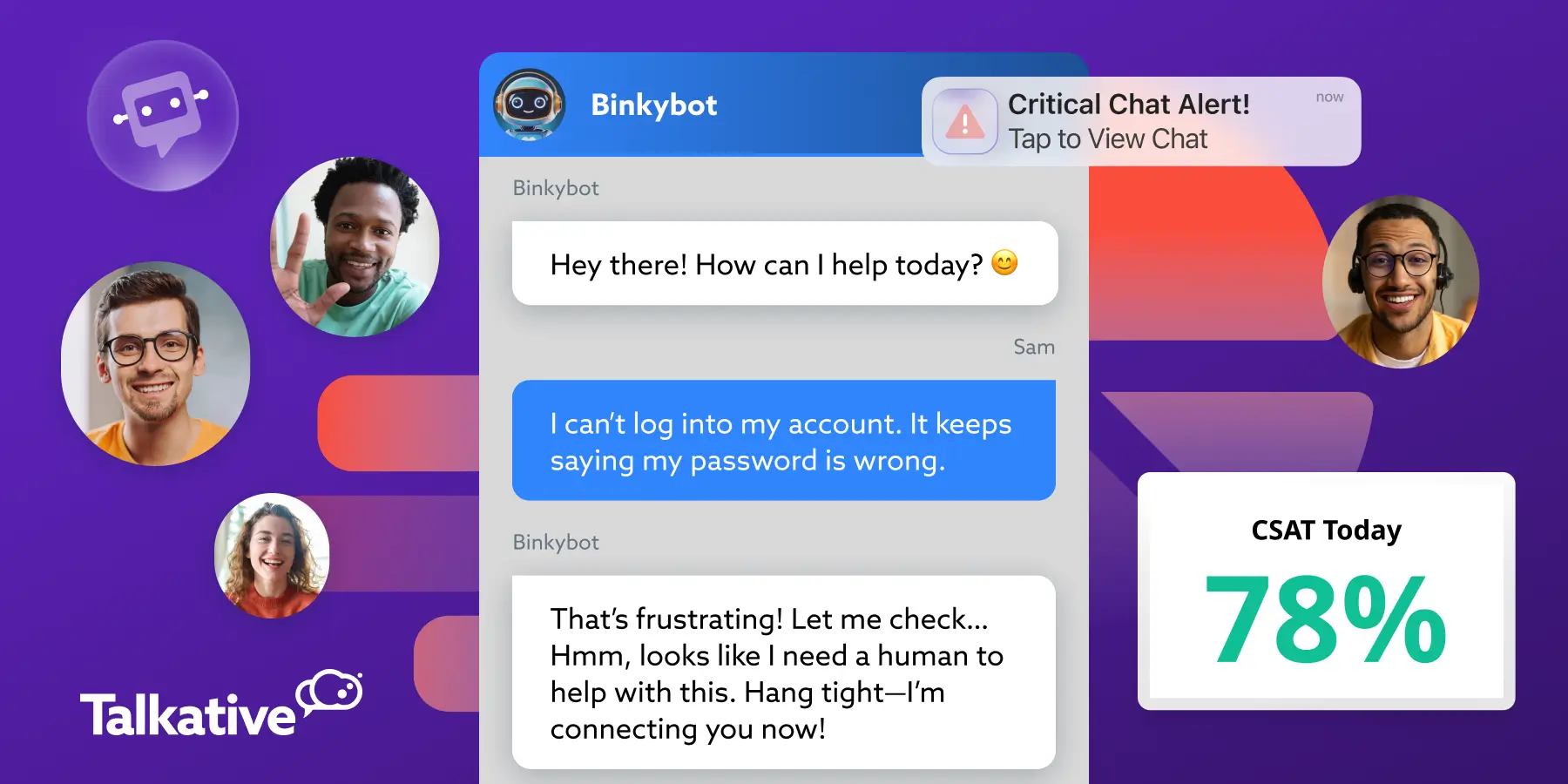
To protect the customer experience post-handover, it’s essential that the AI also provides the agent with the customer’s key details, query intent, conversation history, and any other relevant information.
This context matters.
A cold handoff with no context forces the customer to repeat themselves.
A warm handover gives the agent the information they need to continue the conversation seamlessly, reducing effort for the customer and helping the agent resolve the issue faster.
A well-designed AI Agent should know when to resolve, when to clarify, and when to hand over with context intact.
AI customer service is not a set-and-forget project.
Customer needs change. Policies change. Products change. Demand patterns change. New issues appear without warning.
That’s why continuous AI management and optimisation is essential.
You should utilise AI analytics and reporting to:
If your resolution rate is low, analytics helps you understand why and how to fix it.
The point is to create a feedback loop:
That’s how AI performance and resolution rate improve over time.

Containment and deflection still matter in AI customer service.
They help contact centres understand AI’s impact on queues, agent workload, and contact centre efficiency.
But they shouldn’t be the main measure of success.
The better question is whether the customer got the right outcome with less effort.
That’s what AI resolution rate helps you understand.
It shows whether AI is solving real customer problems, not just absorbing volume. It helps teams spot gaps in knowledge, prompts, integrations, and escalation journeys.
And it gives contact centre leaders a more credible way to prove AI value.
Because a customer who couldn’t reach an agent is not necessarily resolved.
A customer who got the right answer, completed the task, or reached the right human with full context is.
That’s the difference between deflection and resolution. And it’s the metric difference that matters most.
If you’re exploring AI customer service and want to drive resolution, not deflection, Talkative can help you deploy voice and digital AI that’s built on your company's knowledge, workflows, and customer journeys.
Get in touch to discover how resolution-first AI could work for your brand.
Get an evidence-based review of legacy voice self-service and what’s changing in phone support - with practical next steps for CX and contact centre leaders.


