AI Customer Service You Can Trust: What It Means & How to Deliver It
July 30, 2026
Time:
5
mins


Most contact centre leaders now agree they need AI somewhere in their customer service mix.
Fewer are confident they can deploy it without creating a new problem.
The worry usually isn't whether AI can answer a question. It's whether it will answer the question correctly, in the right tone, without making something up or leaving a customer stuck with nowhere to go.
That's the real meaning behind "AI customer service you can trust."
It isn't just a slogan. It's a specific, practical standard that any contact centre can build towards, whatever their starting point.
In this article, we'll cover:
Trustworthy AI customer service comes down to five things working together: strong guardrails, accurate knowledge, controlled behaviour, human escalation, strong security, and performance management.
Here's what each looks like in practice.

Trustworthy AI customer service isn't about how advanced the underlying model is.
It's about whether the answers AI gives are accurate, on-brand, and appropriate for the situation at hand.
It also involves clear rules about the AI’s role, tone, scope, and when to escalate to a human.
Essentially, trustworthy AI is the outcome of several things working together:
When a customer asks about a return, a delivery update, or an account issue, they don't care what's happening behind the scenes with the AI. They care that the answer is right.
That's the practical definition of trust. Not confidence in the technology itself, but confidence in the outcome it produces.
A general-purpose AI model can hold a conversation.
It can’t know your returns policy, escalation paths, or the difference between a routine query and a complaint that needs immediate human attention.
Off-the-shelf AI also has no inherent sense of brand voice or regulatory context. Without grounding and guardrails, it will often answer confidently even when it shouldn't.
But generic AI isn't risky because it's AI. It's risky because it has no grounding in your business, no defined scope, and no reliable way to know when to step back.
For contact centres, the fix isn't avoiding AI.
Doing that means losing out on the potentially huge benefits of AI - including efficiency gains, cost savings, CX improvements, and even increased revenue.
The key is using AI that's built for the environment it operates in, with the right controls in place from the start.

AI guardrails are often framed only as a safety net, something that stops AI from saying the wrong thing.
That's part of the picture, but it's not the whole story.
Done well, guardrails also make AI more useful. They keep it focused on the queries it can genuinely help with, and they tell it exactly when to stop guessing and hand over instead.
Guardrails aren't just anti-hallucination controls. They also help to keep AI secure, consistent, and focused on getting the customer to the right outcome.
In practice, this includes role-based access controls, secure data handling, and clear rules about what the AI is and isn't allowed to say or do.
For a technical gatekeeper assessing risk, this is often the part that matters most.
Defined guardrails are what turn "we trust the AI" into something they can actually document and sign off, alongside standard compliance frameworks like GDPR, PCI-DSS, the EU AI Act, and HIPAA where relevant.
The result, when it's done properly, is an AI Agent that behaves predictably and safely even when a conversation goes somewhere unexpected.
AI is only as trustworthy as what it's been trained to know.
That's why knowledge grounding matters as much as the power of its underlying model.
In practice, this means using your company information (e.g. policies, product/service information, support guidelines, FAQs, etc.) to create an AI knowledge base.
This ensures your AI answers accurately using only the information your business has actually approved, rather than from general assumptions.
Prompts (i.e. the AI’s instructions) work alongside this.
They define the AI's role, tone, and boundaries, so its behaviour and answers stay consistent across channels and within the AI’s scope.
A knowledge-grounded, prompt-controlled AI doesn't need to guess.
It answers using approved information, in the voice your customers expect, and stays within the boundaries you've set for it.
Getting this right takes some care, which is why it's worth reading our guide to writing AI prompts for customer service if you're building this out for the first time.
Get the combination right, and the AI becomes an extension of your existing support standards, not a separate, unpredictable channel your team has to keep an eye on.
.webp)
An AI Agent needa to know the difference between a query it can resolve and one that needs a human.
Just as importantly, when it does hand over to a human, it must carry the conversation history and context with it.
Without context, an AI to human handover becomes clumsy and can disrupt the customer experience or cause frustration.
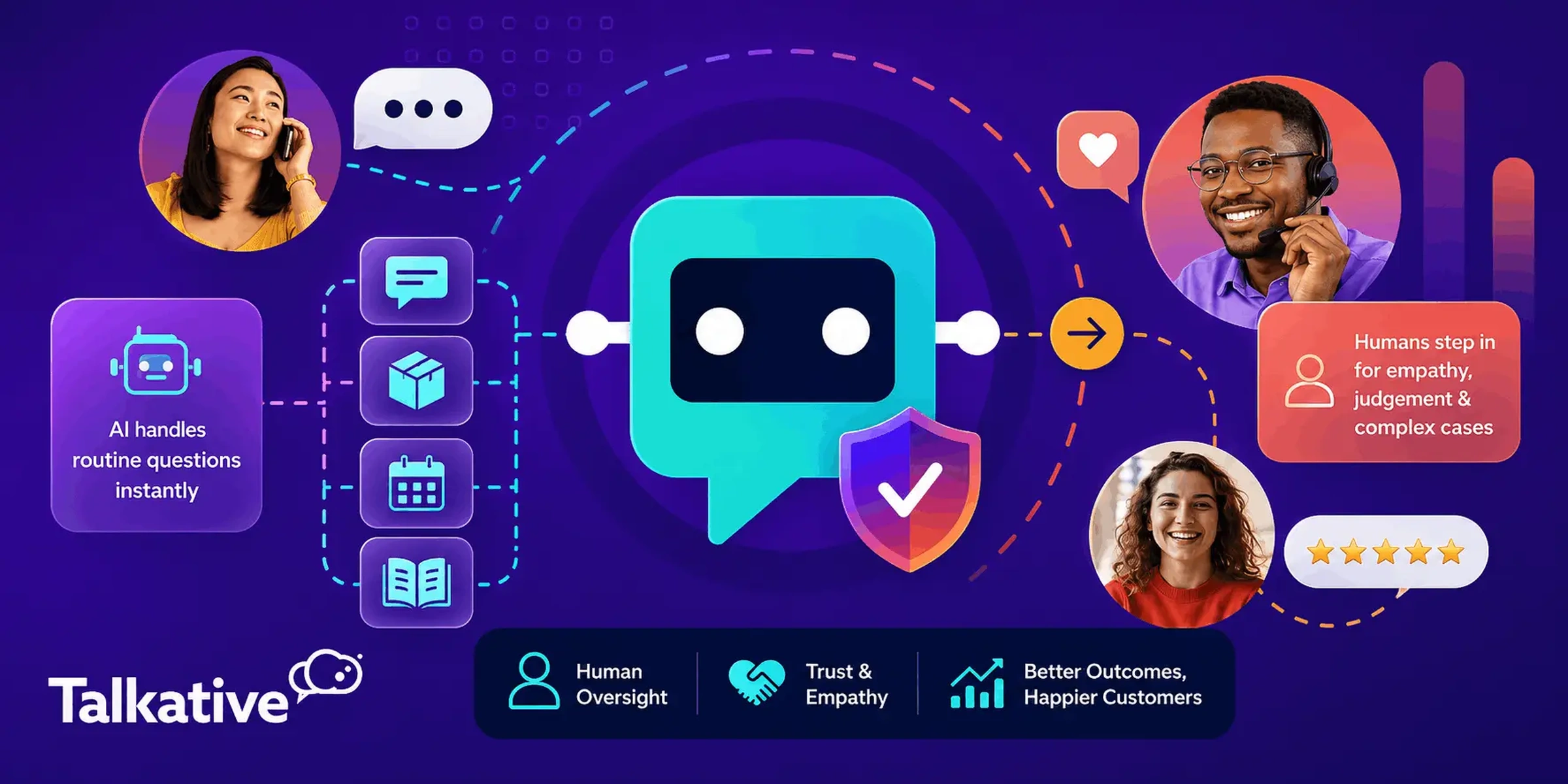
It’s important to note that human escalation isn't a failure of AI. It's part of what makes the whole system trustworthy.
The AI resolves what it can and hands over what it can't, along with everything the agent needs to pick up smoothly.
This is why human-in-the-loop AI customer service is the best approach.
The AI and the agent work as one connected system supporting each other, not two separate channels that happen to sit next to each other.
Done well, customers won’t care that a handover happened. They’ll just be happy that they got the help they needed quickly and smoothly, one way or another.
Trust in AI shouldn’t rest on assumption. It should be something a contact centre can measure, review, and optimise.
That's why ongoing performance management is crucial.
It enables teams to prove that AI is working as intended, identify where it's falling short, and improve responses and service outcomes over time.
Managing AI performance typically involves:
Performance management turns “we think the AI is working” into “we can show exactly how it’s performing, where it’s delivering value, and where it’s improving next.”

For AI customer service to be trustworthy, it needs to be:
Get these pieces right, and AI stops being something contact centre leaders have to cross their fingers about. It becomes something they can measure, defend, and build on.
It also allows businesses to gain all the benefits of AI, without damaging CX or customer trust.
If you’d like to see how this could look for your own contact centre, or want more advice on how to deliver trustworthy AI customer service, get in touch with us today.
Get an evidence-based review of legacy voice self-service and what’s changing in phone support - with practical next steps for CX and contact centre leaders.


