The Pre-Peak AI Tune-Up: A Black Friday Checklist for Your AI Agent
October 8, 2026
Time:
7
mins

Your AI agent might handle everyday customer service perfectly well. But Black Friday is a different ballgame.
The questions change, and so does the volume.
Even your escalation paths can behave differently when every human queue is under pressure.
And AI is now doing more peak-season work than ever.
During Cyber Week 2025, Salesforce found that customer service conversations with AI Agents grew 55% week over week.
And across the entire 2025 holiday season, shoppers used retailers' AI for customer service 126% more than in the previous two months.
So the question isn't whether customers will meet your AI agent this peak - it's whether your AI agent is ready for them.
In this article, we'll cover:
Don't wait for the Black Friday trush to QA your AI agent for you.
A few weeks of targeted tuning is what separates an AI agent that copes with Black Friday from one that creates more work for your team.

Most AI agents are optimised around everyday volumes.
That's the right place to start, but it isn't what they'll have to face in late November.
Peak season changes four things at once.
In a normal week, your AI agent might field order tracking, product questions and account queries.
During peak, customers also ask more about seasonal discount codes, delivery cut-offs, price matching, stock and gift returns.
Some of these questions only come up for a few weeks a year, so your knowledge base may not currently cover them.

Black Friday offers come with discounts, exclusions, end dates, and conditions.
If your AI agent doesn't know the new rules, it will have to escalate queries it could have resolved autonomously.
This creates friction and gives your already busy agents more work that could have been automated.

On a typical day, handing off to an agent might mean a short wait.
During peak season, the same handover could mean an extremely long queue, a frustrated customer, and overwhelmed agents.
Escalation logic that works in October can quietly fail in November.

Customers in a hurry don't stick to one channel.
If your web chat AI gives one answer and your voice AI gives another, you've created two problems instead of solving one.
Remember: Everyday performance shows how your AI agent handles normal volumes, not peak.

Black Friday falls on 27th November 2026, with Cyber Monday on 30th November.
That leaves around seven weeks from early October.
It sounds like plenty of time, but promotion details are often confirmed late, and your team will have its own peak planning to do.
A simple way to plan it:
The tune-up works best as a project with an owner and a deadline, not a task squeezed in around everything else.
Work through the below six steps in order. Each one builds on the last.
Your AI agent can only answer accurately from what it knows.
Before peak, add everything that's true for the season into your knowledge base.
That includes:
Then remove anything out of date, such as last year's cut-off dates.
Old seasonal content is one of the fastest routes to confident, wrong answers.
In Talkative, you keep this approved content in your AI knowledge base, and your AI agent's responses stay grounded in it.
If it's true at peak and not the rest of the year, your AI agent needs to be told.

Knowledge tells your AI agent what's true. Prompts tell it how to behave.
For Black Friday, that means setting clear rules for promotional questions.
Decide in advance:
The last point matters most.
A customer would rather hear "let me check that for you" than receive a promise your team has to break.
With Talkative, you set your AI agent's role, behaviour, tone and rules in our Prompt Builder.
That means you can easily add peak-specific guidance without rebuilding anything.
.webp)
Escalation is a strength, not a failure.
But during peak volumes, an AI handover is only as good as the queue it lands in.
Review your escalation rules with peak capacity in mind:
Getting this balance right is the heart of human-in-the-loop AI customer service, and it matters most when your team is stretched.
Where waits are long, give customers a better option than sitting in a queue, such as a callback or a follow-up by message.
And make sure every handover carries context, so agents aren't asking customers to repeat themselves on the busiest day of the year.
Talkative's AI avoids this by passing on captured details, an interaction summary and a transcript when it escalates to a live agent, for both digital and voice conversations.
A good peak escalation plan protects your team's time as carefully as your customers'.
Peak shoppers move between channels quickly.
A customer might start on your website chat, then pick up the phone when they don't get the answer they wanted.
If your channels say different things, the customer notices, and so does your complaints inbox.
Ensure that:
AI consistency across channels is essential for CX and protecting customer trust.

Your AI agent has probably been tested on everyday queries.
Peak season needs its own test set.
Build a list of the questions you expect in late November, based on last year's contact reasons and this year's promotions.
Include the awkward ones:
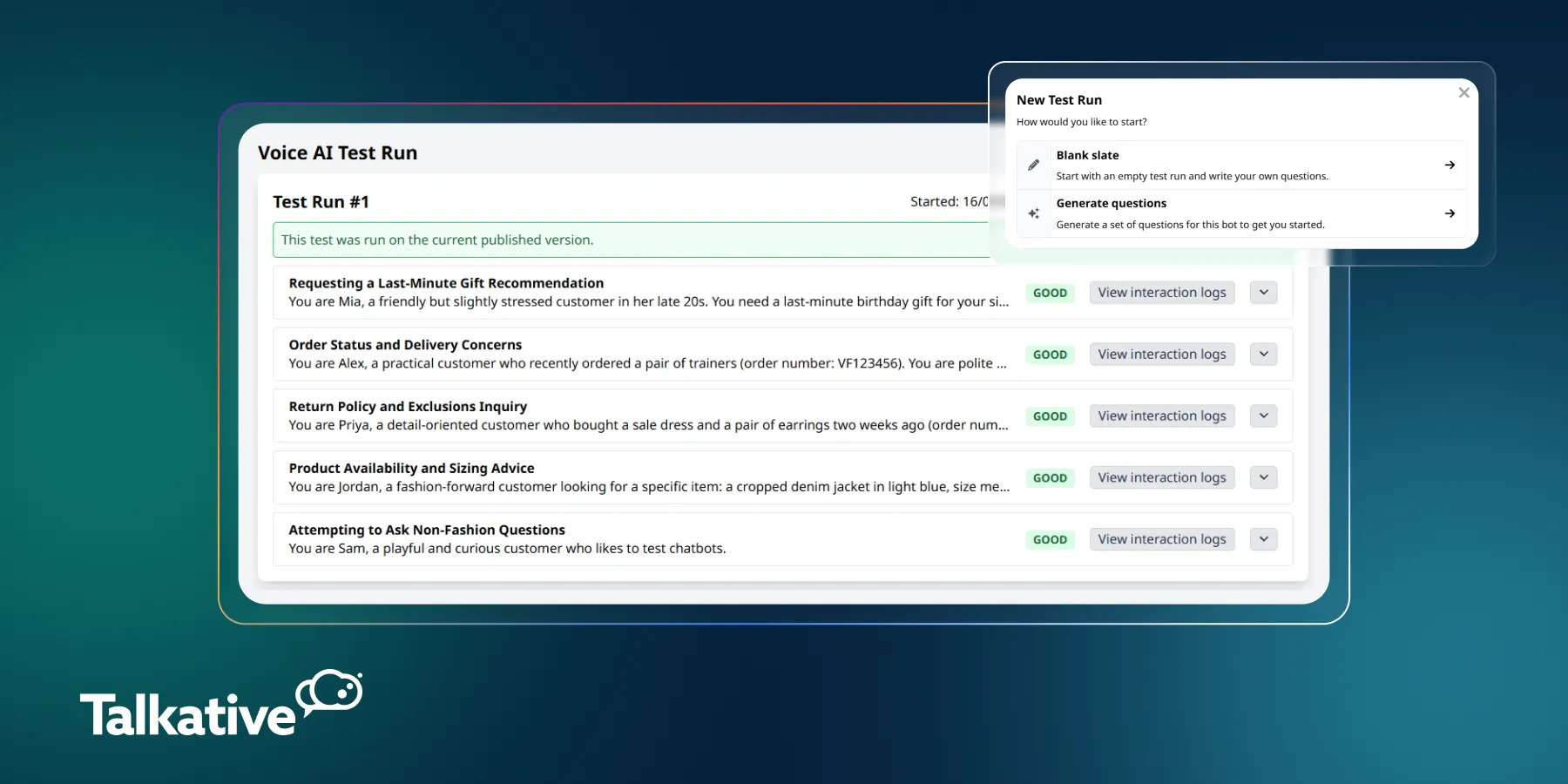
Run each scenario on every channel and check the answer against your knowledge base.
With Talkative, you can do this quickly and easily with our Test Runs feature, which allows you to test how your AI responds to sets of questions across channels.
Note anything that's wrong, vague or inconsistent, and check that escalation triggers fire when they should.
Then fix what you find and test again.
Every wrong answer or knowledge gap you find in the AI testing process is one your customers won't find on Black Friday.
On Black Friday itself, you won't have time to build reports, so decide now what you'll watch and who will watch it.
Useful things to monitor include:
Be sure to agree in advance who can approve a fix during peak, and how quickly.
Then agree a change freeze for the busiest days, so only urgent, tested fixes go live.
It's the same discipline as ongoing chatbot management, compressed into a few critical days.
Peak is the wrong time to discover you can't see what your AI agent is doing.

Peak doesn't end on Cyber Monday.
Christmas delivery questions follow, and returns keep volumes high into January.
Keep your seasonal knowledge content current through that period, then review what peak periods taught you.
The questions your AI agent struggled with this year are the first ones to fix for next year.
Your best preparation for next Black Friday starts the week after this one.
Peak season asks more of your AI than usual with higher volumes, new repeat questions, complex promotions, and stretched queues.
A focused pre-peak tune-up helps close that gap before your customers find it.
But Black Friday AI readiness isn't just about handling higher volumes.
It's about ensuring your AI Agent can deliver accurate, consistent customer service under peak pressure.
Updating seasonal knowledge, refining promotional rules, reviewing escalation paths, and testing across channels will help you identify and resolve potential issues before your busiest period begins.
At Talkative, we work closely with our customers to prepare their AI Agents for peak demand, helping them optimise knowledge bases, refine AI behaviour, and monitor performance throughout the season.
This proactive approach helps ensure your AI Agent can handle increased demand effectively, reduce pressure on your contact centre, and maintain a positive CX.
If you're preparing your AI Agent for Black Friday and want to discuss how to get the most out of AI customer service during peak periods, get in touch with our team.
Get an evidence-based review of legacy voice self-service and what’s changing in phone support - with practical next steps for CX and contact centre leaders.


